Archive
McGehee finds power stroke in sweep
MILWAUKEE — Batting practice was optional on Sunday. But that didn’t stop Casey McGehee from getting out there and putting some work in with hitting coach Dale Sveum.
McGehee, who entered Sunday having hit just .234 with four home runs and 14 RBIs since June 1, was the only Brewers hitter to take batting practice on the field before the game.
Maybe his teammates should let him hit alone more often.
With a three-run homer in the bottom of the seventh inning, McGehee put an exclamation point on the Brewers’ 8-3 victory, helping the team record a sweep over the Nationals.
“It was just me and Dale, we were just talking last night and had some ideas of some stuff that we might want to try, just to get a little better feel,” McGehee said. “Who knows if that had anything to do with it, but I’m just trying to get back to feeling like myself at the plate.”
For McGehee, the blast capped a 2-for-3 day that included a crucial first-inning walk, a double in the fifth, three RBIs and a run scored.
Along with McGehee, second baseman Rickie Weeks helped power the Brewers past the Nationals, belting a two-run homer deep to left in the fourth, which made it 5-0 in the Brewers’ favor.
Weeks’ 20th blast of the season extended the Brewers’ streak to 14 consecutive games with a homer. McGehee’s blast was his 14th this year and his first since July 1 in St. Louis.
“When your pitching is holding you in the games, and one swing of the bat with McGehee or Rickie or Prince [Fielder] or [Ryan Braun] can get you several runs,” said Brewers manager Ken Macha, “you feel like you have a chance to win every game.”
The Brewers got an excellent pitching performance from right-hander Dave Bush and were able to limit the damage of their two errors while taking advantage of two defensive miscues by the Nationals.
Thanks to errors in the first and fourth innings, Nationals starter Ross Detwiler was tagged for five runs on just three hits over 3 2/3 innings. Fortunately for Detwiler, his ERA went unharmed, as all five runs were unearned.
For the Brewers, taking advantage of an opponent’s errors made for a much different story than when the Crew was hurt by errors earlier this month in three losses to the Cardinals and Giants.
“We’ve been on the other side of that, and that’s what happens,” Macha said. “Look what happened in the game in St. Louis and back-to-back games here against San Francisco.
“We had an error and they capitalized and got a bunch of unearned runs. It happens to all the teams.”
Afterward, Nationals manager Jim Riggleman was not happy with his team’s defense.
“We did not have a good day defensively today,” Riggleman said. “Going into the series before the All-Star break and up to the current time, we played better defense. But we certainly didn’t get it done today.”
Bush (5-8) tossed six-plus strong innings, giving up just two earned runs on six hits. More importantly, though, Bush recorded seven strikeouts against zero walks.
Through the first five innings, Bush cruised, retiring 15 of 17 batters faced with just one hit. The key for Bush was his changeup, which he used more often than usual.
“[Jonathan Lucroy] called a couple in the first inning and I got a couple swings and misses on it. I had a decent feel for it today,” Bush said. “It’s typically my fourth pitch. It’s not something I’m going to necessarily use a whole lot, unless I feel like I can put it where I want to and get some outs out of it.
“Today, I felt like I could do that here and there. Lucroy figured that out, too and went to it more than usual.”
Bush ran into trouble in the sixth, leaving curveballs up to the first two hitters. It resulted in a pair of runs coming across on a Josh Willingham sacrifice fly and a single by Adam Dunn. Thanks to a nice defensive play by center fielder Carlos Gomez, though, Bush escaped the inning with the lead intact, stranding a pair.
“I didn’t locate all that well,” Bush said of the sixth. “It was mostly a matter of getting some pitches up and having guys on base.”
With the win, the Brewers picked up their second straight home sweep and improved to 10-4 since July 9.
Milwaukee has won four straight games dating back to the series finale in Pittsburgh on Thursday and six straight at home. Next up for the Crew will be the first-place Cincinnati Reds as it looks to continue its climb back into the race on Monday.
“Any time you can sweep a team, no matter who it is, obviously it is big,” McGehee said. “We’re going to have to do some more of that if we want to make things interesting.”
Jordan Schelling is an associate reporter for MLB.com. This story was not subject to the approval of Major League Baseball or its clubs.
Brewers beat 7/24
Hart happy to find out wrist isn’t broken
MILWAUKEE — A day after slamming his wrist into the wall in right field, Corey Hart said he felt a little sore. The good news, though, is that an MRI on Friday revealed no fracture.
Hart said the exam was a relief: “Especially the way it’s going, I didn’t want to miss too much. I might miss a few days. I’ll take treatment until it stops hurting. I’m lucky I didn’t break anything. It could have been a lot worse.”
Hart injured his wrist Friday in the top of the third inning during the Brewers’ 7-5 victory over the Nationals. As he attempted to catch a long foul ball off the bat of Cristian Guzman, Hart slid and hit his right hand against the concrete wall below the padding.
Hart injured his wrist in a similar region of the ballpark where Braves outfielder Matt Diaz slid into the concrete wall and suffered a knee injury two years ago, which cost him much of the season.
Now it’s just a waiting game for Hart and the Brewers.
Hart was out of the lineup Saturday night, and Joe Inglett got the start in right field. Before the game, Hart sported a compression sleeve on his right wrist, which is intended to keep the swelling down.
Once he feels well enough to play again, Hart expects to return to the field. The Brewers have an off-day Thursday, which could give him an extra day of rest before returning.
But that’s not exactly his plan.
“I’d like to be in before then,” Hart said. “I’m probably not going to play these next two. Hopefully I’ll get at least a couple games against the Reds.”
Lucroy gets another shot at catching Parra
MILWAUKEE — Brewers manager Ken Macha shook up his catching rotation Saturday night, putting rookie Jonathan Lucroy behind the plate with lefty starter Manny Parra.
Over his past three outings, Parra had been paired with backup catcher George Kottaras. Lucroy struggled with stopping Parra’s splitter, which resulted in several wild pitches.
“I had that because of balls getting back to the screen on the split,” Macha said. “I just feel that we’re going to try this fit because of results we can get with Manny, so we’ll try somebody else back there.”
In three starts this month with Kottaras behind the plate, Parra has a 1-2 record with a 10.89 ERA, allowing 19 earned runs over 16 innings on 28 hits, including five home runs.
Conversely, in five starts with Lucroy catching during the month of June, the Brewers left-hander went 1-2 with a 4.18 ERA, allowing 13 runs on 29 hits (four homers) over 29 innings.
Parra had 36 strikeouts against 13 walks in June, compared with 12 against seven this month.
So does Macha think having Lucroy behind the plate is going to result in a better outing for Parra?
“I don’t know, we’ll see,” Macha said. “How did he do last time out? Sometimes catchers and pitchers get on the same page and it happens.”
Hawkins set for another rehab outing Monday
MILWAUKEE — Veteran reliever LaTroy Hawkins will rejoin the Brewers soon, but not before Tuesday at the earliest.
Manager Ken Macha said before Saturday’s game that Hawkins would pitch for Triple-A Nashville again Monday as he continues to rehab from right shoulder weakness.
“We’re just going to evaluate his Monday outing,” Macha said. “We’ll go from there.”
Hawkins pitched for the second straight night Friday, tossing 16 pitches over two innings while allowing just one hit as he earned the save.
Macha was hesitant to confirm that Hawkins would rejoin the club after his outing Monday, based on Hawkins’ own evaluation of his rehab outings, which Macha received from Brewers trainer Roger Caplinger.
“One of his other outings he kind of indicated he wasn’t really on top of his game quite yet,” Macha said. “I just got that report from Roger. I didn’t talk to [Nashville pitching coach] Rich Gale or anyone like that. Rick Peterson, our pitching coach, will talk to Rich Gale sometime.”
Worth noting
The Brewers’ comeback on Friday night, after being down 5-1 to win 7-5, marked their largest comeback victory of the season. They had previously come back from three-run deficits five times. … Milwaukee had homered in 12 straight games entering Saturday’s contest, going 8-4 during that stretch. It marks the longest streak for the Brewers since they homered for a franchise-record 20 straight games from July 1-24, 2008. … Prince Fielder entered Saturday’s game just one RBI shy of 500 for his career. He would become the 12th player in franchise history with at least 500 RBIs. … Rickie Weeks is on pace for 102 RBIs this season, all coming from the leadoff spot. Weeks would be just the second leadoff hitter in MLB history to eclipse the 100 RBI mark, joining Darin Erstad, who did it in 2000 with the Angels.
Jordan Schelling is an associate reporter for MLB.com. This story was not subject to the approval of Major League Baseball or its clubs.
Uecker happy to be back at ballpark
MILWAUKEE — A familiar face and voice has returned to the Brewers’ broadcast booth.
Hall of Fame broadcaster Bob Uecker, who had been gone since April after having heart surgery, was back Friday in his familiar role alongside Cory Provus as Milwaukee’s play-by-play announcer.
Before the series opener with the Nationals on Friday, Uecker was his usual self.
“I’m ready to rock and roll,” Uecker said to open his news conference. “The doctors kind of said, ‘OK.’ They knew I was coming back anyway, so there was nothing they could do.”
Uecker announced that he would work every home game through the end of the season while also covering select road trips.
As for where he might travel, Uecker suggested close cities such as Chicago and Cincinnati, as well as San Francisco because he “likes it there.”
“I’m really looking forward to coming back and working,” Uecker said. “Depending on how I feel, and I think I’m going to feel OK, I’m going to go back to work.”
Surgeons replaced Uecker’s aortic valve, a portion of his aortic root and performed a coronary bypass on one vessel on April 30. He was expected to return within 10-12 weeks, but a staph infection slowed his progress.
Uecker said the infection, his inability to put the weight back on — he’s still 10 pounds down from before the surgery — as well as getting the right mix of medications have been the biggest struggles since he’s been away.
Even with the setback of the staph infection, however, Uecker’s return Friday came exactly 12 weeks to the date of the surgery.
“It’s been a long haul,” Uecker said. “Not from the surgery. I got that staph infection right after we had the last [news conference]. That was the thing that really put me down. I don’t know if it ever goes away. I’m still on a lot of medication for that.
“It something that attacks new things in your body.”
Uecker said he had an 80 percent blockage in his aorta, though he “never had a pain, never had a problem.”
“I noticed the first night I was breathing better,” Uecker said. “I was breathing easier, not that I ever had a problem. … Now I feel stronger. I really do feel better.”
While he was away, Uecker joked that he was renting people to come stay with him due to the boredom of being away from Miller Park for so long.
That, he said, was what he missed most during his time off: being in the clubhouse, around the guys and being with Provus and producer Kent Sommerfeld in the radio booth.
“Every day at a certain time, you’re supposed to be at the ballpark. When you can’t go to the ballpark, it’s terribly boring,” Uecker said. “When you’re around here as long as I’ve been here and you make friendships, you miss that stuff.”
Uecker’s doctors, Aldred C. Nicolosi and Jim Kleczka, in recognition of the work they did on the Brewers broadcaster, were given the opportunity to throw out the ceremonial first pitches before Friday’s game.
After mentioning it, Uecker — right on cue — shared his thoughts about how they might do.
“I hope they do better than they did on my incision,” Uecker joked. “I hope they throw a good pitch tonight. They’re all fired up about that.”
Provus said earlier in the week that Uecker would have his usual pregame show with Brewers manager Ken Macha while doing play-by-play for six innings to Provus’ three.
So how would Uecker make his return to the broadcast booth even better?
“I’d like to win, I’d like to win all the time,” Uecker said. “I don’t worry about what I say or do. I could make stuff up. In my mind, we’ll win. But I want them to win. I always want them to win.
“Winning is a lot more fun in the broadcast booth.”
Jordan Schelling is an associate reporter for MLB.com. This story was not subject to the approval of Major League Baseball or its clubs.
Brewers’ 1992 club highlighted tough decade
MILWAUKEE — Some of the great moments in Milwaukee Brewers history occurred in the 1990s, the third decade in franchise history. But for all those moments, there were not many wins to go along with them, and even fewer winning seasons.
After finishing second in the American League East and posting just the fifth 90-win season in club history in 1992, the rest of the decade did not go nearly as well for the Brewers. In fact, the Brewers did not have another winning season, or even a .500 record, through the rest of the 90s.
This weekend, as a part of the 40th anniversary of the move from Seattle, the Brewers are celebrating and reflecting on the club’s third decade in Milwaukee. On Friday, the Brewers will wear reproductions of the club’s 1997-99 uniforms, featuring “BREWERS” in block letters on the front, while the cap features an “M” logo.
On Sunday, all fans in attendance will receive a collectible bobble head doll featuring Hall of Famer and Brewers legend Robin Yount recording his 3,000th career hit on Sept. 9, 1992, a sharp single to right field at County Stadium.
The Garner Era
Despite a winning 1991 season, the Brewers introduced a new general manager, Sal Bando, and a new manager, three-time All-Star infielder Phil Garner, before the next season. Much like the club’s first year under previous manager Tom Trebelhorn in 1987, the Brewers’ 1992 season was among the best in club history.
With just over a month remaining in the season, they put together one of the best offensive displays in club history. On August 28, the Brewers scored a franchise-record 22 runs, while setting an American League record with 31 hits in a 22-2 victory over the Toronto Blue Jays.
But while that certainly was a memorable moment in one of the greatest seasons ever for the Brewers, three other aspects of the 1992 season stand out as the true highlights.
One of those was 24-year-old rookie shortstop Pat Listach, whose arrival with the big league club came due to an injury to Bill Spiers.
After spending the previous four seasons in the Minor Leagues, Listach was perhaps the biggest surprise of the season for the Crew.
“Pat had his bags packed for Denver,” said Garner in the book “True Blue,” referring to the Brewers’ Triple-A affiliate at the time. “Then he went out and had a Rookie-of-the-Year-type season. He was a consistent, solid player from Day 1.”
Listach batted .290 in his rookie season while driving in 47 runs and recording 54 stolen bases, becoming the first Brewers player to swipe more than 50 bases in a single season.
That performance earned Listach the American League Rookie of the Year Award as well as a handful of votes for AL MVP in 1992.
“Rookie of the Year. That’s a pretty good first season,” Yount said of Listach. “He was an exciting player. What I remember specifically about him was that he seemed to deliver a large amount of big hits that season, which is unusual for a rookie.
“He was able to deliver in key situations numerous times, which impressed me quite a bit because he was such a young player coming up so big for us so often.”
As great as Listach’s individual season was, the Brewers as a whole put together their best campaign since the club’s AL-pennant-winning season of 1982.
As the Brewers’ leadoff hitter, Listach led an offense that featured Yount in center field, B.J. Surhoff behind the plate, Greg Vaughn in left field and designated hitter Paul Molitor, playing his final season with the Brewers.
Milwaukee finished 92-70 in Garner’s first year at the helm, good for the fourth-best record in franchise history. The Brewers ended the season four games out of first place in the AL East, behind the Toronto Blue Jays, who went on to win the World Series.
Though they came up short in the end, the Brewers thrilled fans in the season’s final month, posting a 20-7 record in September. In the club’s home finale, the Brewers beat the Oakland A’s, 5-3, on Sept. 27, to complete the sweep and cut the Blue Jays’ lead to just 2 1/2 games with six games remaining in the regular season.
“The players need to take a curtain call,” Garner told reporters that day after a standing-room-only crowd of nearly 55,000 gave the Brewers a standing ovation. “They could not have played more inspiring ball than they have the last five or six homestands.
“There was an air of excitement all around today.”
3,000 hits
Of course, Yount had a handful of highlights of his own in the 1990s.
Along with the pennant race and Listach’s impressive rookie campaign, the 1992 season was highlighted by Yount’s push for 3,000 career hits.
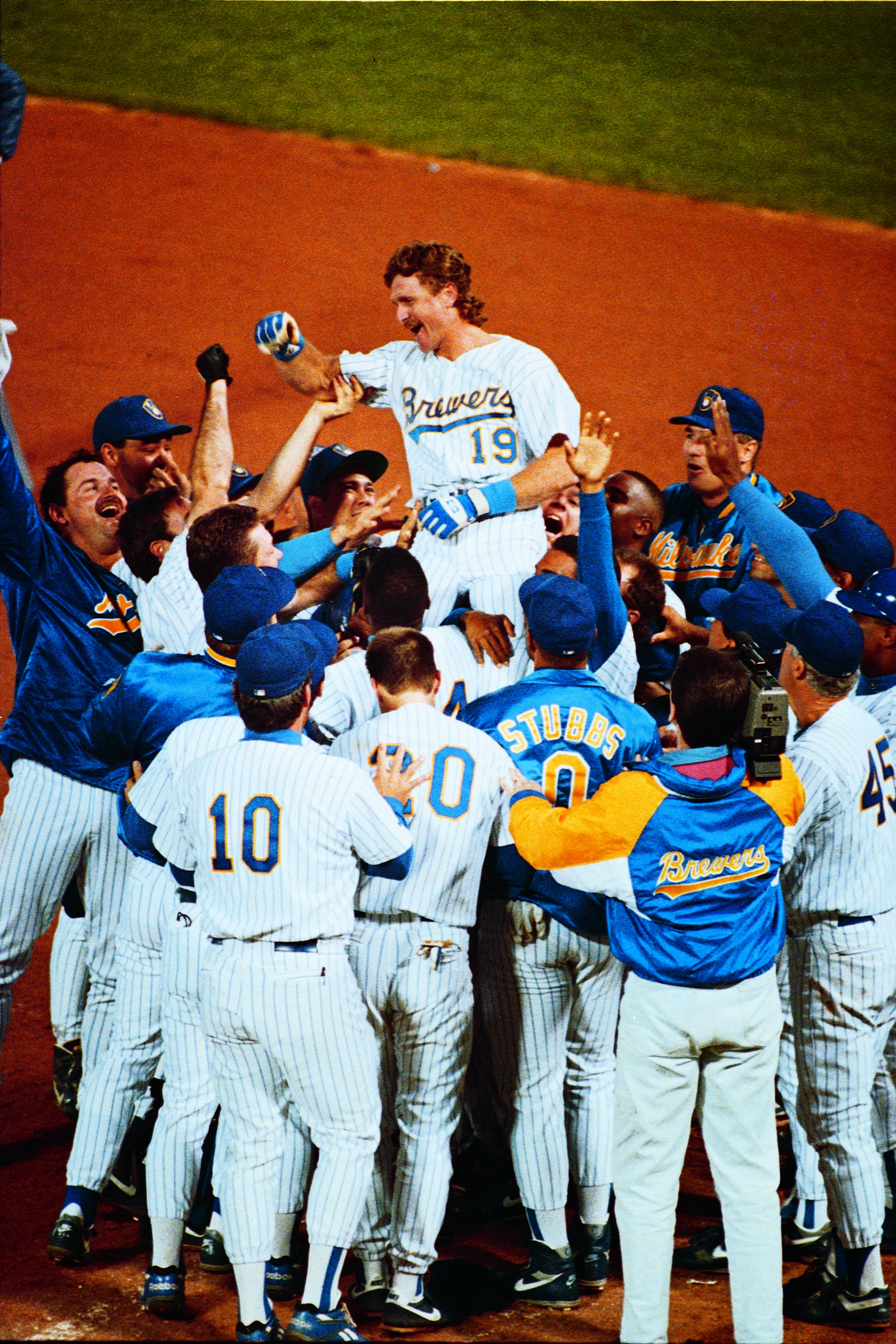
The moment finally came in early September. With a seventh-inning single to right field off Cleveland pitcher Jose Mesa on Sept. 9, 1992, at County Stadium, Yount became the third-youngest member of the 3,000-hit club at 36 years, 11 months and 24 days old.
After collecting the hit, Yount was mobbed by teammates and lifted onto their shoulders in a celebration that lasted nearly 10 minutes.
“Obviously it was an exciting moment,” Yount said. “But it was more about the pennant race than the 3,000th hit for me. It was September and every game meant something.
“Certainly, the 3,000th hit was a highlight from an individual standpoint, but more importantly, we were in a pennant race, so that made it doubly exciting.”
Yount retired after the 1993 season with 3,142 career hits.
A year later, on May 29, 1994, Yount had his No. 19 retired by the Brewers in a ceremony at County Stadium. As a part of the festivities, the Brewers and Harley Davidson gave Yount a new motorcycle, which he rode a lap on around the stadium, recalling memories of his famous ride following the 1982 World Series.
“That was always fun,” Yount said of the motorcycle ride. “It kind of ended up to be a circus a little bit, but I’ll ride a motorcycle any time somebody gives me a chance.”
Five years later, Yount was honored again, this time by the Baseball Writers Association of America. Included on 77.5 percent of ballots in 1999, Yount was a first-ballot Hall of Famer, the first player to ever enter Cooperstown wearing a Brewers cap.
During his speech, Yount borrowed from Lou Gehrig’s famous farewell address.
“Now’s the time where I’m supposed to wake up from all of this. I mean, it’s OK, it’s been a great dream,” Yount said. “But if in fact this is reality, then with all due respect Mr. Gehrig, today, I consider myself the luckiest man on the face of the Earth.”
We’re taking this thing National
In the years between Yount’s retirement and his induction into the Hall of Fame, a number of changes were introduced by Major League Baseball.
First, in 1994, the Central Divisions were added in the AL and NL. The Brewers, along with the White Sox, Twins, Indians and Royals, formed the AL Central Division.
The Brewers would spend just four seasons in the AL Central, however. In 1998, the Tampa Bay Devil Rays and Arizona Diamondbacks joined the AL East and NL West, respectively. Their addition forced the move of one club from the American League to the National League, in order to preserve an even number of teams in each league.
After the Royals opted not to switch leagues, the Brewers decided to make the move.
“I think it’s a wonderful thing for baseball,” former home run king Hank Aaron said at the time. “It’s a great day for Milwaukee. Milwaukee’s first identification was with the National League.
“Nothing against the AL. They won a championship there [in 1982]. But we won a World Series [in 1957].”
Thanks to a pair of home runs by Jeromy Burnitz, including a grand slam in the top of the 11th inning, the Brewers secured their first National League victory on April 2, 1998.
Fittingly, they defeated the Atlanta Braves, 8-6, at Turner Field.
“I was ready to get out of here,” Burnitz told reporters after the game. “I hope all our National League games aren’t this tough.”
Jordan Schelling is an associate reporter for MLB.com. This story was not subject to the approval of Major League Baseball or its clubs.
 A Schelling For Your Thoughts
You must be logged in to post a comment.