Archive
Marlins beat, 9/23
Hanley out again, still considered day-to-day
MILWAUKEE — Hanley Ramirez was out of the lineup on Thursday for the fifth time in six games, and the Marlins’ shortstop may not return this season.
“From what I saw in the last game that he played, he said he felt worse than the day before,” said Marlins manager Edwin Rodriguez. “That’s not a good sign. If that’s what’s going to happen, I’d rather not play him until I see any real improvement.
“If he’s going to get worse, it doesn’t make any sense to throw him out there.”
Ramirez has been sidelined due to inflammation in his left elbow. He missed four games before going 1-for-4 with a strikeout and a run scored in Tuesday’s 5-2 win over the Mets, and sat once again on Wednesday.
In his place, rookie Ozzie Martinez made his third start at shortstop on Thursday with Emilio Bonifacio also unavailable. Rodriguez said Ramirez continues to receive treatment on his elbow and may see some limited action on the basepaths.
“He’s available to pinch-run, but we’re not going to throw him out there while he’s in that condition,” said Rodriguez. “So far, he’s day-to-day.”
Bonifacio should return to Marlins on Saturday
MILWAUKEE — If everything goes according to plan, the job of Marlins manager Edwin Rodriguez may get a little easier on Saturday, when he expects infielder Emilio Bonifacio to return.
Bonifacio, who has been sidelined with left hamstring tightness, ran and hit in the cage on Thursday. Everything went well, according to Rodriguez, but he did not expect Bonifacio back in the lineup for Friday’s game.
“Even if he’s OK tomorrow, I would keep him out of the lineup,” Rodriguez said. “I would count on him as a pinch-runner or pinch-hitter, just to make sure he’s fine. Saturday, I’m pretty sure he would be in there, if everything goes well.”
With Bonifacio unavailable, Rodriguez is without one of his most valuable and versatile options on the team.
Bonifacio provides his manager with the luxury of his ability to play all three outfield positions as well as second base, shortstop and third base.
“Having him and [being] unable to use him, it’s really tying my hands,” Rodriguez said. “He can play everywhere, he can do everything. It’s tough to manage without him, because you can count on him for everything.”
Martinez already a big star in Puerto Rico
MILWAUKEE — He made just his third Major League start on Thursday for the Marlins, but shortstop Ozzie Martinez is already a big star in Puerto Rico.
“Right now, he’s a hero in Puerto Rico,” said Marlins manager Edwin Martinez, who hails from Ponce, Puerto Rico. “He’s a nice story, and the country’s paying attention.
“He’s having so much fun. He brings so much energy to the field, it’s amazing. Everybody’s rooting for him.”
Martinez has drawn plenty of attention from the media in his home nation, including from sportscaster and writer Fufi Santori.
Recently, Santori wrote “Un Canto Para Ozzie Martinez,” and put together a video featuring himself singing the song.
“People really respect [Santori], so coming from him, it was really nice to see that,” Rodriguez said.
Injuries to the Marlins’ first two options at shortstop — Hanley Ramirez (left elbow) and Emilio Bonifacio (left hamstring) — have given Martinez the perfect opportunity to audition for a more permanent job in the Major Leagues.
According to his manager, Martinez has already displayed a number of qualities that bode well for his future success at the big league level.
“He’s fearless. He looks like he’s very confident that he belongs here,” Rodriguez said. “The way he’s been playing, the way he’s been taking every at-bat against very good pitching … he’s very, very close to making himself a big leaguer on a full-time basis.”
In three games with the Marlins entering Thursday, Martinez has batted .286, collecting two hits, two walks, a run scored and a strikeout. Martinez, who is better known for his defense than his offense, has looked even better so far in the field.
Asked if Martinez’s defense would be what kept him in the big leagues early on, Rodriguez offered his assessment of how he thought things would pan out in the near future.
“I picture him to start off as a utility guy — second, short, third base,” Rodriguez said. “Eventually, he will make himself an everyday player.”
Homegrown Olympians throw out first pitches
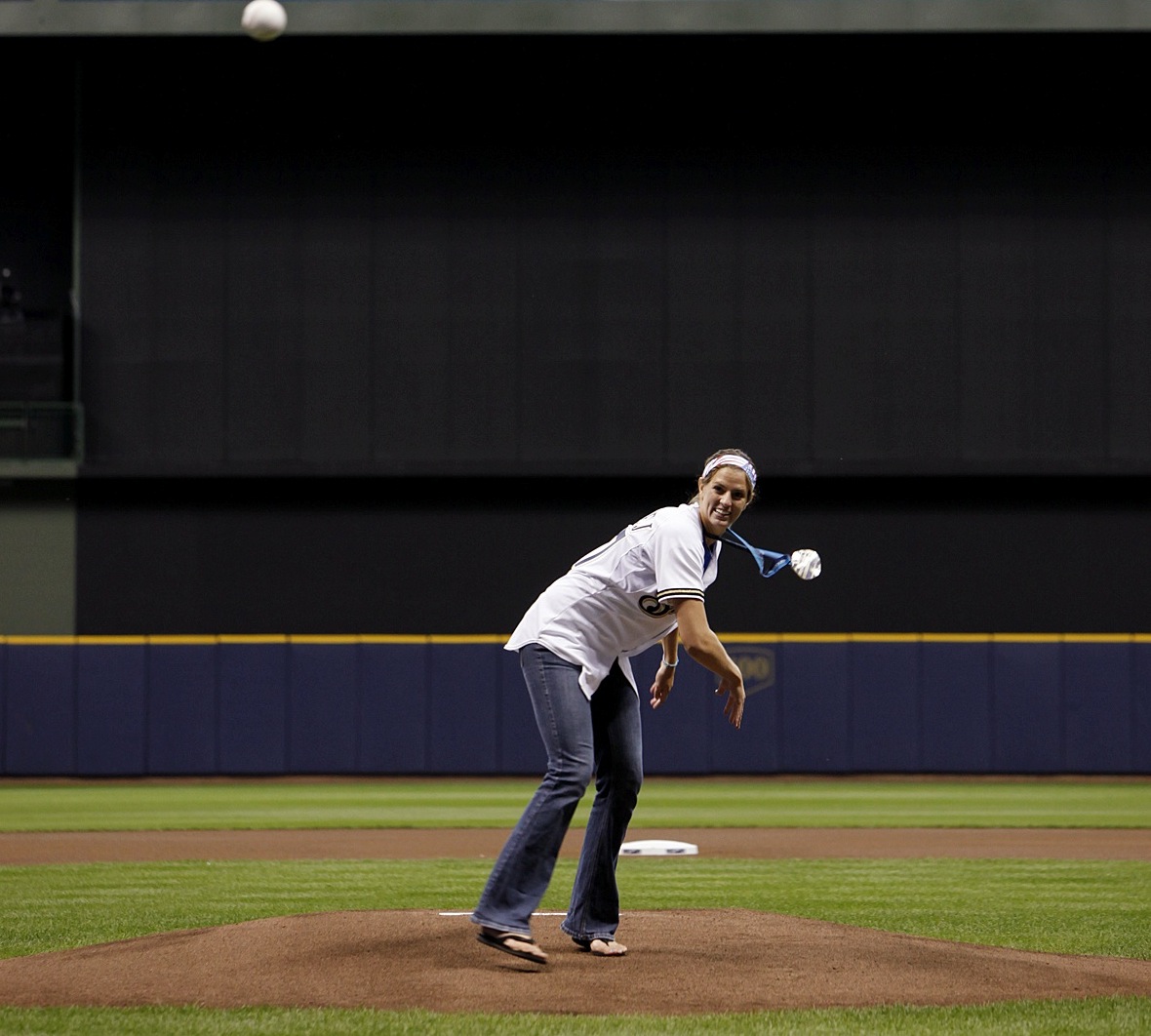

MILWAUKEE — It was a big night Wednesday for Wisconsin athletes at Miller Park, capped by veteran infielder Craig Counsell’s three-run homer in the second inning. Before Counsell’s heroics, though, a pair of homegrown Olympians shared the spotlight.
Tossing ceremonial first pitches before the Brewers hosted the Reds were goalie Jessie Vetter and forward Jinelle Zaugg-Siergiej of the United States’ silver-medal winning women’s hockey team.
Since their final game against Canada in February, Vetter and Zaugg-Siergiej have been keeping busy with a number of guest appearances, including one at a Milwaukee Admirals game. So how did throwing a pitch in front of 27,004 fans at Miller Park rank?
“It’s pretty special because Jessie and I are both from Wisconsin,” Zaugg-Siergiej said. “Being able to throw an opening pitch and doing it in your home state, especially now that I’m living in Milwaukee, it means a lot, it’s a lot of fun.
“It’s a great feeling to represent something bigger than yourself and bigger even than Milwaukee with Team USA and the Olympics.”
Vetter and Zaugg-Siergiej are from Cottage Grove and Eagle River respectively. The two were teammates on the Wisconsin Badgers’ national championship team in 2006.
Between celebrating their silver medal victory with the rest of the country through various appearances and coaching and playing hockey, the two have remained busy in the offseason.
In fact, Zaugg-Siergiej recently got a new job, which resulted in her moving to the Milwaukee area.
“I actually just accepted a coaching position out at Arrowhead for their girls team,” Zaugg-Siergiej said. “I’m also coaching a U14 winter club youth team. Between those two I’m still playing myself, so I still travel and play and train all that kind of stuff.
“In the summers I also run a camp, so the entire summer was incredibly busy.”
While it was not the most well-attended game of the season for the Brewers, Miller Park still exceeded the 16,805 in attendance for the gold medal game in Vancouver on Feb. 25.
Vetter and Zaugg-Siergiej each stepped up in front of that crowd and delivered strong pitches to catcher Jonathan Lucroy behind the plate.
“I got a little nervous, but it was fun,” said Zaugg-Siergiej, who added that Vetter’s pitch was the more impressive of the two. “I’m just glad I made it on target all the way to home plate. She did play baseball growing up and I’ve never played baseball before.
“Hers was pretty hard. I’m going to give her that one.”
Wolf flies under the radar in lopsided victory
MILWAUKEE — On any other night, Randy Wolf’s performance would have been the story of the game. But with the way the Brewers hitters were swinging the bats in a 13-1 victory over the Reds, a quality start and a 2-for-4 performance at the plate got lost in the shuffle.
Making Wolf’s outing even more impressive was the way he responded after his club put up eight runs in the second and five more in the next three innings. Often with such long innings offensively, a team’s pitcher tends to struggle going back out on the mound.
Wolf just got better as the game went along.
“There were some long breaks, but the main thing is, when it’s that kind of score, you’ve got to go out there and feel like it’s 0-0,” Wolf said. “If you go out there and you see it’s 8-1, 13-1 … all of a sudden it’s four runs, five runs and they’re creeping their way back.
“As a pitcher, you’ve got to keep your focus and pitch the right way. You really don’t want to totally change your aggressiveness or change your whole philosophy just because of the score.”
Not only did Wolf pitch well as his team sent 34 hitters to the plate in the second through fifth innings, he did so after fighting through a rough first inning.
Wolf opened the game giving up three singles and a walk in the top of the first. Fortunately, the veteran lefty managed to hold the National League Central-leading Reds to just one run in the inning.
“Wolfy, another good outing for him,” said Brewers manager Ken Macha. “He got help with some defense in the first inning, a tremendous play by [Ryan] Braun getting the ball off the wall to get their leadoff hitter.”
With a fortunate out on his side, Wolf got the next batter to hit a grounder back to the mound. But with just one out to go in the inning, he walked Jay Bruce and surrendered back-to-back singles before striking out Yonder Alonso to end the inning.
That strikeout was the first of four in a row for Wolf and the beginning of a stretch of 11 consecutive batters retired. Wolf did not allow another hit until a leadoff double in the sixth off the bat of Paul Janish, who replaced Orlando Cabrera at shortstop.
“I didn’t really have the command I wanted early on,” Wolf said. “Luckily, as the game went on, I felt better and better and felt more comfortable out there and I was able to mix my pitches and work my fastball in and out.”
Tossing six strong innings while allowing just one run on four hits with seven strikeouts against two walks, Wolf posted his fourth straight quality start in September. This month, Wolf is 3-1 with a 1.21 ERA, allowing just four runs on 18 hits in 29 2/3 innings pitched.
Since his infamous 12-run outing in Pittsburgh, Wolf has gone 6-2 with a 2.57 ERA in his last 11 starts, giving up 21 earned runs over 73 2/3 innings pitched. In his 31 other starts not including that July 21 loss, Wolf is 13-10 with a 3.81 ERA.
“Randy was great again,” shortstop Craig Counsell said. “He’s been on quite a roll, and he’s put together a good season — a really good season.”
Brewers beat 9/22
McClendon causes stir with quick pitch
MILWAUKEE — As manager Ken Macha sees it, what Brewers reliever Mike McClendon does with two strikes absolutely is not an illegal quick pitch. The four Reds batters McClendon struck out on Tuesday night would likely disagree.
After he struck out third baseman Scott Rolen to end the seventh, home-plate umpire Dan Bellino told Macha he thought it was a quick pitch, though he didn’t make the call.
“He said the hitter wasn’t looking,” Macha said. “Go back and look at the tape, the hitter was looking. But sometimes what happens is the umpire gets caught off guard.”
In the eighth, McClendon continued to work with a shorter, quicker delivery after two strikes, and he struck out the side doing so.
The last of McClendon’s four strikeout victims was catcher Ramon Hernandez, who was noticeably upset afterward, pleading his case with Bellino.
“I don’t think in McClendon’s situation that it should even be in the conversation,” Macha said. “He takes a step back, he does his drop step, and then after he gets to his balance point, either he’s slow or he goes fast. There should not even be a question for that.”
McClendon’s manner of pitching in such situations is acceptable, so long as no runners are on base. With the bases empty, the requirement of coming set before pitching is not in play.
As far as Macha is concerned, pitching quickly is no different than switching up between a fastball and an offspeed pitch. It’s all designed to do the same thing to the hitter.
“The idea of pitching is to disrupt the hitter’s timing,” Macha said. “You do that by throwing changeups and fastballs and all that stuff. This is just a little variation of it, and I see absolutely nothing wrong with it.”
Another National League Central pitcher, Cardinals starter Jake Westbrook, pitches with a similar style to McClendon’s. When facing him, Brewers hitters made a concerted effort to call timeout to prevent any potential quick pitch.
So who’s at fault in the quick pitch issue?
“Is it on the hitter? He’s in the box,” Macha said. “If he knows the pitcher is going to do that, it’s up to him to call time.”
Cruz not seeing much playing time
MILWAUKEE — Since being recalled from Triple-A Nashville on Sept. 7, shortstop Luis Cruz has pinch-hit twice for the Brewers, once in Houston and again in San Francisco.
Cruz has yet to start a game for the Brewers, and though he started nearly 40 games in two years with the Pirates, his manager did not wish to start him against contenders like the Giants and Reds.
After playing in 129 games for the Sounds this year, sitting and watching from the bench is a new role for Cruz.
“I’m just working hard to see whenever they find a chance for me and let me play, that’s the only thing I can do,” Cruz said. “You want to play and help the team win, but the manager is the manager. He’s the one that sets the lineup, and he’s got to pick the guys that he thinks are going to help win games.”
With their official elimination from the playoff race on Sunday, though, the Brewers aren’t going anywhere, regardless of how many games they win. Add in the fact that they need to go 12-0 the rest of the way to finish at .500, and the need for winning games would not seem too high.
Learning what they can about September callups like Cruz, however, would seem like a priority. According to Macha, that’s likely to come in the next two series against the Marlins and Mets, both of whom are also on the outside looking in at the contenders.
“I had thrown a crazy idea out there this morning, I don’t know if I’ve got the nerve to do that,” Macha said without giving any additional details. “It’s a little further out of the box than playing Luis Cruz.”
Joining Cruz in watching from the dugout has been Mat Gamel, who also started one game at third base with Prince Fielder out of the lineup.
Any out-of-the-ordinary lineup against the Marlins would likely include Gamel as well, though what defensive position he would play is uncertain. Before Wednesday’s game, Macha had good things to say about Gamel’s outfield abilities.
“He was running them down in the outfield,” Macha said. “He was outstanding in right field. Watching him run balls down today, he was pretty good.”
Breaking ball key to Braddock’s future
MILWAUKEE — Watching from the home bullpen this week, Brewers lefty Zach Braddock could learn a lot from Reds phenom Aroldis Chapman.
Both pitchers possess left-handed power arms, albeit on different levels. Both pitchers also operate with a slider as their No. 2 pitch. The difference — besides an extra 10 mph in fastball velocity — is the effectiveness of those sliders.
While Chapman’s is nearly unhittable, Braddock’s remains a work in progress.
“He is going to be as good in the big leagues as his breaking ball becomes,” said Brewers manager Ken Macha. “You just can’t come here and just throw one fastball after another, and being 93 [mph], it’ll get knocked around a bit.”
In six appearances this month, Braddock has posted a 7.71 ERA, giving up two runs on two walks and three hits in 2 1/3 innings. Opponents are batting .333 with a .795 OPS off Braddock in September.
For the first time this season, Braddock failed to record an out in each of his last two outings, surrendering a hit to the only batter he faced in each appearance. Aside from a 9.00 mark in three late May outings, Braddock’s 7.71 ERA this month is easily his worst in any month of the season.
Even worse has been Braddock’s performance against lefties, which could likely be attributed to a lack of effectiveness with his breaking ball.
After holding left-handed hitters to a .091 batting average in July and hitless in August, they are batting .400 off Braddock this month.
With those recent struggles in mind, Macha opted not to pitch the lefty Monday night against left-handed-hitting slugger Joey Votto with one on and one out in the eighth. Macha pointed to the last two games in San Francisco to back up his thought process.
“[Kameron] Loe came in and went right through their guys, [Aubrey] Huff being one of them,” Macha said. “The next day, I brought in Braddock against Huff and he hit a line drive. So, I figured Loe could go two innings.”
When asked if Braddock’s performance could be attributed to fatigue at the end of a long season, Macha pointed to the need for a better slider as a counter argument.
Braddock agreed with his manager’s assessment, though he believed his fastball was equally important to his success.
“When I have the ability to change speeds and move in and out, I can be more deceptive. I’m a better pitcher,” Braddock said. “I think strike one and fastball command is of a lot of importance, too. But with the slider comes the added ability to put in the hitters’ minds that there’s something else.”
Capuano’s solid start undone by late homers
MILWAUKEE — With every start, Chris Capuano continues to make progress in his return from a second Tommy John surgery. On Monday, the 100-pitch mark was his latest milestone.
Capuano delivered an impressive performance for his third straight quality start, but back-to-back Reds home runs in the eighth made the difference as the Brewers lost their second straight game, 5-2.
Tossing six innings, Capuano gave up two runs on four hits and three walks with seven strikeouts. Reaching the century mark for the first time this season, Capuano’s pitch count of 105 was his highest since throwing 113 pitches on Aug. 19, 2007.
“This was a huge step for him,” said Brewers manager Ken Macha. “Not only getting past 100 pitches, but the game pretty much on the line [in the sixth inning]. First and second with one out, he winds up getting two big outs there.”
Since his rough return to the rotation on Aug. 28 against the Pirates, Capuano has excelled, posting a 1-2 record with a 2.58 ERA in four September starts. Over that stretch, Capuano has allowed just seven earned runs on 17 hits in 24 1/3 innings of work.
In each of his five late-season starts, Capuano has progressed with his pitch count, going from 75 pitches to 80, 83, 90 and 105 on Monday. His best outing came Sept. 8 against the Cardinals when he tossed seven innings while giving up one run on four hits.
While he wasn’t quite as sharp against the Reds, he said he felt even better.
“Physically, this was the best I’ve felt,” Capuano said. “I really felt good out there physically, and got the pitch count up there close to 100. It felt good.”
But did Capuano feel the effects of tossing 100 pitches for the first time in three years?
“No, I feel good,” Capuano answered. “Like I said, I think this is the best I’ve felt so far.”
Unfortunately for Capuano and the Brewers, they were unable to keep the Reds from reducing their magic number even further. After their win Monday, coupled with a Cardinals loss, the number was down to six.
After leaving with the game tied at 2, Capuano handed the ball off to reliever Kameron Loe, who delivered a scoreless 1 1/3 innings before letting things get away from him. With one out in the eighth, Loe (3-5) surrendered a single and back-to-back home runs as the Reds took a 5-2 lead.
Following an Orlando Cabrera single, Joey Votto belted a 2-2 fastball into the second deck in left-center field, putting the Reds on top, 4-2. Afterward, Macha was asked if he considered anyone other than Loe against Votto.
“You’ve got a way to go yet in the game,” Macha said. “[Zach] Braddock really hasn’t been on his game, and [Manny] Parra needed a day off, he had 20-some pitches.”
With no left-handers available and apparently not wanting to use closer John Axford, Macha stuck with Loe, who he viewed as his best option at the time.
Votto had struggled through his first three at-bats, going 0-for-3 against Capuano while being called out on strikes twice. His night went from bad to great with one swing of the bat in the eighth.
“The more times you face him, the better chance he has,” said Reds manager Dusty Baker. “I always say you hate to see a good hitter cold. Sooner or later the law of averages is on his side and he’s going to get somebody. That was as long of a home run to the opposite field I’ve seen.”
Added Votto: “I try not to take previous at-bats into following at-bats. I didn’t have a very good game going into that point. That’s why we play all nine innings.”
Even after the two-run homer, Loe stayed in, and Scott Rolen drove his very next pitch over the fence in right. It was the Reds’ 11th set of back-to-back home runs this season.
Loe made himself unavailable for comment after the Brewers’ 5-2 loss.
With the loss, the Brewers dropped to 36-39 at Miller Park this season. As only six home games remain on the schedule, they’ll need to win four of six to finish at .500 on the year and five of six to secure a winning home record in 2010.
Milwaukee finished 40-41 at home last year after posting four consecutive winning home records. Lately, the bright spot has been the Brewers’ ability to compete with some of the league’s best — or hottest — teams in the Reds, Phillies, Cardinals, Giants and Astros.
Offensively, Ryan Braun and Rickie Weeks provided the only bright spots for the Brewers. Weeks went 2-for-3 with a double and two runs scored, while Braun drove in a pair of runs and doubled. Braun’s two RBIs moved him one behind third baseman Casey McGehee, who leads the Brewers with 94 runs batted in.
As it has been most of the season, the problem for the offense was delivering hits with runners in scoring position. The most obvious example came in the second inning, when Carlos Gomez led off with an infield single and reached third on a throwing error with none out. With three straight strikeouts, the Brewers left Gomez stranded at third.
“Gomez is on third, nobody out, we didn’t put the ball in play,” Macha said. “Little things like that hurt you when you’ve got tight games.”
 A Schelling For Your Thoughts
You must be logged in to post a comment.