Archive
Morgan says stop sign “was a deke”
MILWAUKEE — Nyjer Morgan ran through a stop sign from third base coach Ed Sedar on his way to scoring the winning run in Wednesday night’s 3-2 Brewers victory.
That much we know, and there’s no doubt about that. Unless of course you believe the replay showed Morgan being tagged out at the plate, then that’s an entirely different story.
But the question Thursday morning was this: Did Sedar put the stop sign up just for show, or was it definitely a signal for Morgan to retreat back to third base? Well, it depends whether you are more inclined to believe Morgan or Brewers manager Ron Roenicke.
“It was a deke for the other team,” Morgan said with a grin. “It was a deke. I can’t tell you that, but it was a deke. It got ’em, too.
“If you see the replay, he second-guessed himself that little bit.
“[Sedar] said, ‘Anything close, anything in the vicinity, I’m going to put up the stop sign, but still you go.
“Never underestimate the sneakiness, guys, come on.”
After further review, that is to say asking Roenicke about it, it would seem there was no decoy intended in Sedar’s actions.
“I guess I can’t answer that then, I’d give away his secrets,” Roenicke said, before acknowledging decoy signals are not common in such situations in the Major Leagues.
“But like I said last night, sometimes you want a player to instinctually do things that he sees. And even when it doesn’t work out, we have to be OK with that.”
Roenicke also noted that he’s been through similar situations in the past when he was a third base coach with the Angels under manager Mike Scioscia. Sometimes the coach has to make the decision too soon, especially if he stays up closer to the base. And when he goes farther down the line as Sedar did, the runner may put his head down and miss the sign, which Morgan indicated also was the case in this situation.
What the runner is supposed to do with Sedar up the line is to go, but pick up the sign on his way to the plate. But Roenicke still gives his players the freedom to make the decision themselves if they’re so inclined.
So, what did Morgan see on the play that made him decide to go home on such a short flyball?
“I knew we had to get home. It was a quick turnaround the next day,” Morgan joked.
“Caught him (Kemp) flat-footed. He’s still one of the best center fielders in the game, one of the best ballplayers in the game. I’m always up for a challenge, and it was one of those where we had the crowd in it, the momentum was there, time to go home.”
As far as the question or whether he was safe or out, Morgan definitively — and unsurprisingly — believed he was safe. The Dodgers saw the replay differently, as it appeared that the tag may have been applied just before Morgan dragged his knee across the plate.
“But you can’t change it now,” he said.
“I knew I was safe.”
Gamel, Kottaras help Crew snap 4-game skid
MILWAUKEE — It was just the kind of win the Brewers needed.
Coming in off a four-game losing streak, including a three-game sweep in Atlanta, the Crew needed a win to get back on the right track. With a two-run walk-off pinch-hit double in the ninth, George Kottaras delivered that victory, 5-4, over the Dodgers.
“It was a great ballgame,” Brewers manager Ron Roenicke said. “I was happy with the way we went about it.”
After Yovani Gallardo rolled through four innings — retiring 10 in a row at one point — the Dodgers put four runs across in the last five innings to set up a potential victory, which would have been their seventh straight and 10th overall. The dagger was a two-out, two-run homer by Andre Ethier to give the Dodgers their first lead of the night.
But the Brewers answered back with a thrilling two-run ninth to pick up their fifth win of the season.
After Corey Hart led off with a single, Carlos Gomez pinch ran and stole second base. A walk by Mat Gamel and a Jonathan Lucroy strikeout brought Kottaras to the plate. Kottaras crushed a 2-2 slider to the gap in right-center field, scoring Gomez easily from first.
Gamel was waved around and, with the help of an excellent slide, scored the winning run.
“Once I rounded third, man, I put my head down and dug as hard as I could,” Gamel said. “I looked in time to see [Travis] Ishikawa tell me to slide, so I just tried to get around it. Fortunately I did.”
That display of speed in scoring from first and sliding ability getting in under the tag by Ellis capped a big night for Gamel, got the Brewers on the board early with a 420-foot solo homer in the second inning. He’s now batting .282 with a home run and two RBI in his first year as the Brewers’ starting first baseman.
Kottaras’ double continued his torrid start. Despite batting just 12 times this season, the backup catcher is tied for the Brewers’ team lead in RBI with eight. Did that hot start help him Tuesday in such a big situation?
“You just kind of have to approach each one the same,” Kottaras said. “We just take pride in our at-bats. Go up there and have a good one and see what happens.”
The Brewers have gotten off to a slow start this season, due in large part to pitching, but the entire team has struggled at times in all facets — pitching, fielding, hitting, base-running. They still made a handle of mistakes Tuesday, including a pair by Rickie Weeks (one on the basepaths that may have cost a run, and one at second base that helped the Dodgers plate a run).
But for the most part, Tuesday was one of the better games this season the Brewers have played. Gallardo was strong, pitching seven innings while allowing two runs on seven hits with one walk and seven strikeouts. Weeks, Gamel and Cesar Izturis each picked up a pair of hits while the Crew collected nine total as a team. And while he went hitless, Aramis Ramirez hit the ball hard all night.
Plus, the Brewers executed yet another perfect suicide squeeze, with Norichika Aoki laying down a sacrifice bunt and picking up the first RBI of his MLB career as Gamel scored from third.
The night’s only real blemish was the one that nearly cost the Brewers the game: Ethier’s two-run blast off Francisco Rodriguez in the eighth. But that didn’t matter when Gamel and Kottaras picked him up in the ninth.
If they can consistently play like they did Tueday, the Brewers should have another strong season in 2012.
“Obviously, the last four games on the road trip didn’t go our way,” Gallardo said. “We’re here at home for nine games and we got it started on the right foot.”
That could be all it takes to spark a winning streak with a long homestand ahead.
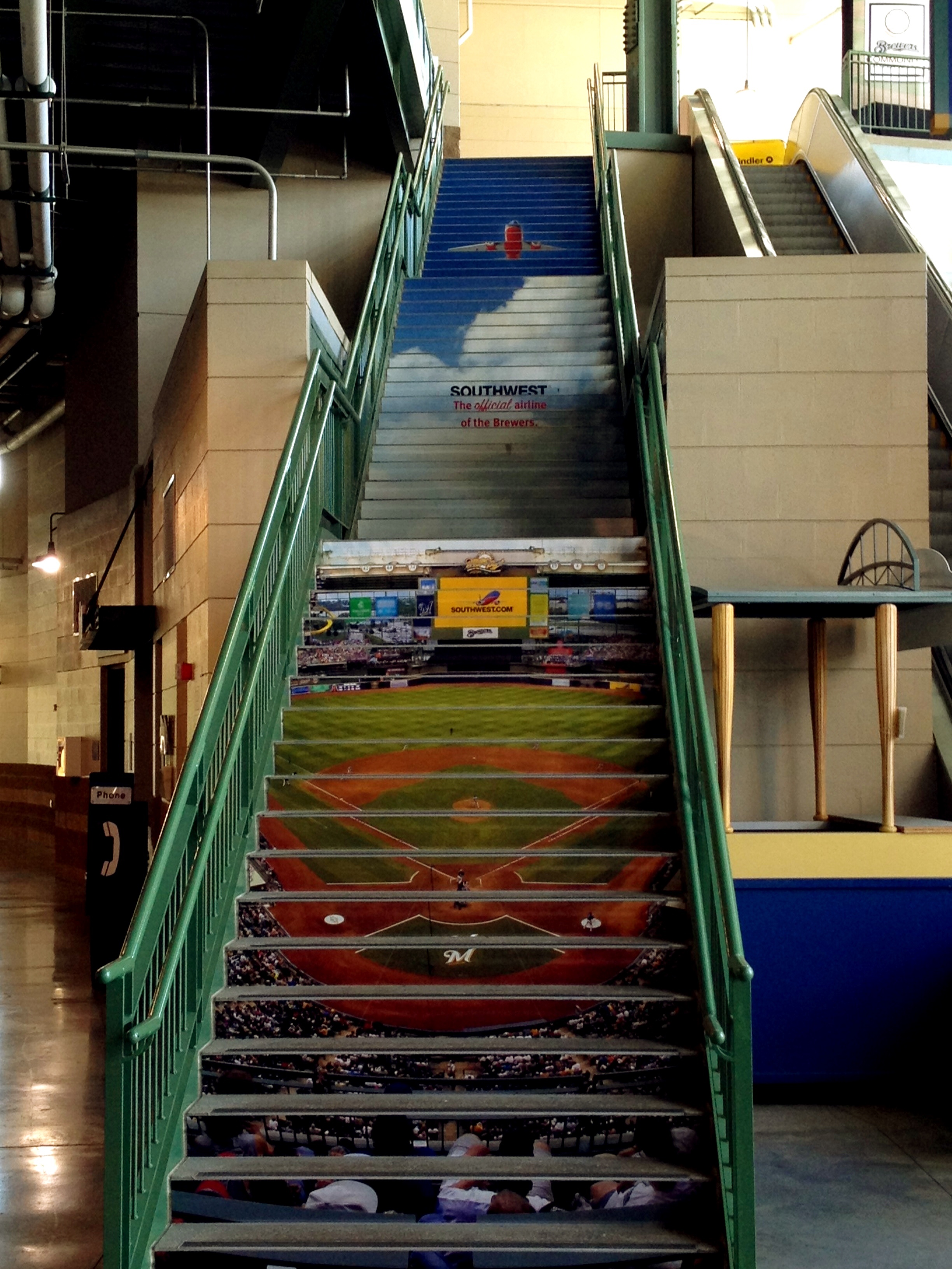
Check out this Southwest Airlines ad
I think it’s pretty great.
Axford talks pitching, elbow injuries, Tommy John surgery
MILWAUKEE — Even as the workload of pitchers decreases, the injuries seem to be mounting with increasing frequency. Especially elbow injuries, and especially with closers.
That was the premise of a story written today by Tom Verducci for SI.com. As he sees it, the injury trends point to a need for rethinking the modern bullpen in which relievers — outside of a select group of long relief pitchers — are limited to single innings or at-bats in very specific situations.
Left-handed relievers often face strictly left-handed batters late in ballgames. Managers like Tony La Russa have no problem running out three different relievers for three batters in a single inning: right-hander to face righty at the plate, lefty versus lefty, and then back to the right side. Or vice versa.
The alarming thing is that while pitchers’ workloads are generally decreasing, the likelihood of injury seems to be on the rise. Just this week, Giants closer Brian Wilson went down with a season-ending elbow injury that will require his second Tommy John surgery.
Here are some of the statistics from Verducci’s story:
- Sixty-six percent of 2011 Opening Day closers (20 of 30) are no longer closing for the same team 12 months later, with seven of them hurt.
- Fifty percent of all starting pitchers will go on the DL every year, as well as 34 percent of all relievers, according to research by Stan Conte, director of medical services for the Los Angeles Dodgers. That bears repeating: half of all starting pitchers will break down this year. (“When I did the research,” Conte said, “I was so surprised I figured I must have done the math wrong.”)
- Injuries last year cost clubs $487 million — or about $16 million per team. The bill since 2008 for players who can’t play is $1.9 billion.
As for guys like Wilson, going through the surgery a second time, 70 percent of relievers make it back while only one in 10 starters returns following a second operation and lengthy rehab.
A couple more stats from Verducci:
- The past two seasons mark the first time since the save statistic became official in 1969 that nobody saved 25 games with 81 innings in back-to-back full seasons. Bailey, with the 2009 Athletics, is the only closer to do so in the past four years.
- Over the previous five seasons, 53 closers saved 25 games at least once. Thirty-three of them, or 62 percent, no longer are closing.
- Only five pitchers saved 25 games three times in the past five years and are still closing: Jose Valverde, Mariano Rivera, Jonathan Papelbon, Heath Bell and Joe Nathan
With all that in mind, I talked this afternoon with Brewers closer John Axford about the story and the injury trends, to assess his feelings and level of concern about the likelihood of injury and seemingly short lifespan of pitchers in his role.
Here’s what he had to say:
Do the injury trends worry you at all?
“No, not particularly. As far as injuries go, that happens to anybody, whether you’re a starter or reliever. I don’t think it matters whether you’re specified as a closer or not. As a pitcher in general I think you’re more susceptible to injury than a position player.”
“It’s nothing I think about every single day, that’s for sure.”
Do you ever think at all about the fact that as a closer you’re likely to have a short lifespan in the role?
“Some people do, some people don’t. It just depends on the trend and the people that they want to look at. Once again, it’s not something I really look at and think about too much.”
Did you ever talk to Trevor Hoffman about how he was able to last in the role so successfully for such a long time?
“Really, just his work ethic. Just watching him work day in and day out, you could just tell his determination and dedication every single day. I think that’s really what it takes.”
“Obviously for Trevor, too, it was a matter of San Diego. Him wanting to be there, taking an opportunity when he had it, and obviously the team wanting him to be there also. So if I’m given the opportunity to stay in Milwaukee, I obviously would love to do that. I think you have a better chance of staying with that same club than testing free agency and popping out everywhere as a closer. That doesn’t seem to go over quite as well. Unless you’re Papelbon, I guess.”
Would the likelihood of injuries make you more likely to want to sign early if offered an extension?
“I know how hard I work, I know the effort I put in every single day. I know my body and I know what it’s capable of. Same with the team. They’re pretty trustworthy and they’re pretty open to both sides. If I tell them I can’t pitch on a particular day, they know they won’t put me in. Even if I say I’m OK, sometimes Ron [Roenicke]’s going to say, ‘No, we’re going to give you a day off.’ If it’s early in the season, obviously, why not give a guy a break when he needs a break? And Ron and Kranny [pitching coach Rick Kranitz], they’re great about that. They’re great about making sure that the relievers and everybody has the time that they need.”
“So I don’t think I’m going to get overworked, and I know how hard I work. So I don’t feel like an ‘injury waiting to happen’ by any means.”
Another thing mentioned in the story is the setup of the bullpen and closers being limited to late-inning save situations, if it were up to you would you stick with that or pitch whenever high-leverage situations came up? Fifth-inning, sixth inning?
“I don’t really know. Maybe not that early. I think my mentality’s kind of made up now towards the end of the ballgame. I really enjoy that role. Obviously in 2010, I was in there in the eighth inning at times for some saves. So I got some two-inning saves, some four- and five-out saves. Those opportunities I think really kept me focused out there as well. Having the bullpen we have now, though, everything is really role-oriented… so there isn’t much that you need to do to deviate from that.”
Can you compare your arm now to what it was like before Tommy John surgery?
“The way the doctor described it was, it was a few pieces of string that’s now become a noose rope. I had what many people do not, which is a lack of a tendon in my wrist. So they used my hamstring. So it was thicker and stronger, and they looped it through four times. Generally it used to be two, then they started switching to three. They could do four really easily with me because I had such a prominent elbow bone, my bone sticks out prominently enough, so they looped it through four times. That’s why it sticks out even more now, unlike [the other] side, which just goes straight.”
“He said, as long as I continue to pitch in baseball and work the way you normally would and work hard, I should never have another elbow problem again. And I haven’t. It’s been unbelievably strong since. Obviously it took a little longer to come back than I wanted because I was trying to figure out my arm path again. … But as far as the elbow is concerned, I’ve never had a problem with it since.”
Do you think there should be any concern in baseball in general about the increase in injuries despite the decrease in workload?
“Not to attack anyone’s work ethic, but it could be just a matter of how people are going about their work. If you’re doing a little too much throughout the year, that could affect it. If you’re not doing enough throughout the year, that could affect it. So many little things could affect an injury. Something small, something big.”
“The elbow is such a tough thing. Throwing a baseball is the most unnatural thing you can do in sports, other than serving a tennis ball. So it’s going to put a lot of strain on your elbow. You just have to take care of it. Certainly you have to understand and know of your body. If you’re putting too much strain on it outside of your throwing program and outside of the games, then obviously that’s not going to be good. But if you’re not doing enough to maintain your shoulder work and elbow work, then you’re going to hurt it then too.”
How well do you know BrianWilson and what did you think when you heard he would be having a second Tommy John surgery?
“We played together when I was in the Cape in 2002. But that was the only time I ever met him. And that was just before he had his first Tommy John, and just before I had my first Tommy John.”
“It’s concerning because he had his in 2003 and that’s when I had mine too. So it’s interesting to think about. Obviously I don’t want to think about it too much because it’s the same timeframe for both of us. But it’s a tough break for him, tough break for the Giants.”
Easter Sunday: 25 years later
Easter Sunday is a special day for Brewers fans. And not just because of the feast and festivities that come along with the Christian holiday.
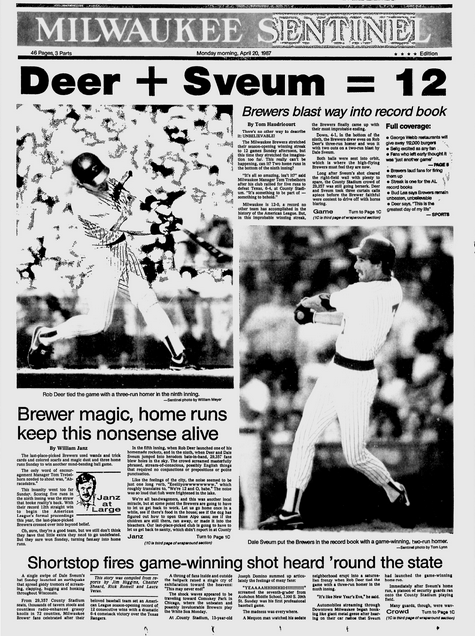
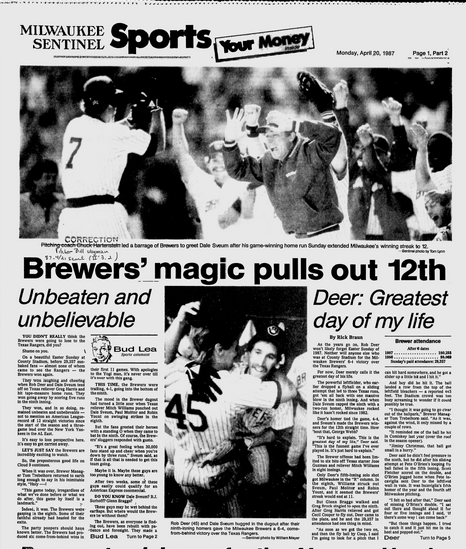
One of the most memorable games in Brewers history was 25 years ago on Easter Sunday, as home runs by Rob Deer and Dale Sveum on April 19, 1987, carried the Brewers to a 6-4 victory. More importantly, it extended Milwaukee’s season-opening win streak to 12 games.
A week later, that streak landed Deer and the Brewers on the cover of Sports Illustrated:

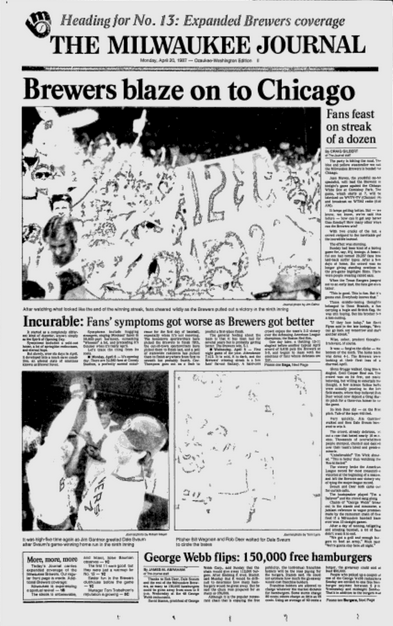
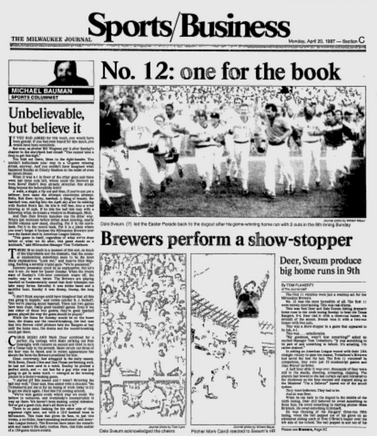
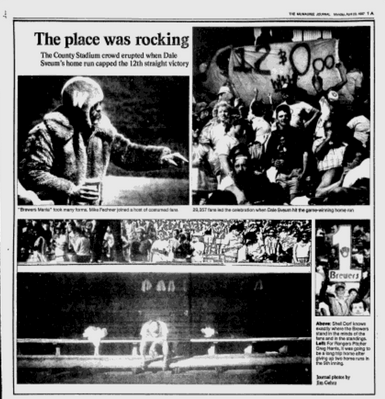
Looking back on that game today, I searched the newspaper archives from that Easter Monday.
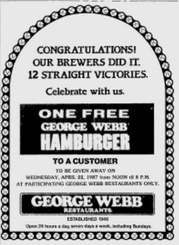
Here are some screenshots of the Milwaukee Journal and Milwaukee Sentinel coverage:
And here’s something I wrote about the game two years ago for MLB.com:
To open what turned out to be a wild and wacky season, the Brewers tied a Major League record, winning its first 13 games of the year. One month later, the club lost 12 in a row.
But the 13-game stretch to open the season is among many Brewers fans’ favorite memories. Along the way, two highlights stand out.
First, in the team’s ninth game of the season, lefty Juan Nieves tossed the first no-hitter in franchise history, blanking the Orioles on April 15, 1987, at Memorial Stadium in Baltimore.
Nieves became the first Puerto Rican-born pitcher to toss a no-hitter, but he couldn’t do it without a little help from Yount, who made a tremendous no-hitter-saving catch in center field for the 27th and final out.
“There’s no way I wasn’t going to catch that ball,” Yount said. “When I saw it, I just took off running. There’s no time to think in that kind of situation. So I just reacted and luckily I got there and was able to be part of the Brewers’ only no-hitter.”
Three days later, the current Brewers hitting coach delivered the most famous home run in Brewers history, on Easter Sunday no less.
With the winning streak on the line, the Brewers headed to the ninth down, 4-1. At that point, the might have Brewers thought it was over, as did their fans. With that in mind, the crowd of 29,357 gave a standing ovation in appreciation for the 11-game win streak.
But it was far from over.
With two on and one out, slugger Rob Deer crushed a 1-0 curveball out to left, tying the game at 4-4. Rookie B.J. Surhoff followed Deer with a strikeout, but after a walk was drawn by Gantner, the switch-hitting Dale Sveum had a chance to make it 12 in a row.
He did just that.
With a full count, Sveum got a cut fastball, waist-high over the middle of the plate. Sveum jumped on it and blasted a two-run walk-off homer, sending County Stadium into a frenzy, as the Brewers had won their 12th straight to start the season.
“It was one of those games where nobody really wanted to leave,” said Brewers infielder Craig Counsell, a Wisconsin native who stood in the stands that day as a 16-year-old. “If you were there, you’d remember it.”
So, for those of you old enough (I was not born for another 10 months), what do you remember about that day, that game and those home runs?
Hart powers Crew past Cards; Greinke brilliant in 2012 debut

Corey Hart's second-inning home run was estimated at 447 feet, landing at about this spot.
MILWAUKEE — So much for easing Corey Hart into the regular season.
After a knee injury in Spring Training required surgery, it was unclear whether Hart would be ready to go on Opening Day for the second year in a row.
Through two games, Hart appears to be in midseason form.
Following a 1-for-2 performance Friday, Hart blasted two no-doubt home runs Saturday as the Brewers picked up their first win of the season, 6-0, over the Cardinals.
“I think it was big for us to come back today and show that we’re still a good team,” Hart said. “I think we did that.”
Hart’s first homer went deep into the second deck in left, while the second was a two-run shot to center field. Between the two, Hart had an estimated 860 feet worth of home runs on the day.
Not bad for a guy with a knee that is not yet at 100 percent.
“He’s really seeing the ball well,” said manager Ron Roenicke. “Hopefully he’ll come in tomorrow feeling well and we can get him back in there.”
Rickie Weeks also homered in the game, while Aramis Ramirez had a key RBI double in the sixth inning for his first hit in a Brewers uniform. Add in a 2-for-3 day by Ryan Braun — with a pair of doubles, a walk and a run scored — and the Crew showed just how good the offense could be this year, even without Prince Fielder batting cleanup.
All they really needed Saturday was the one run, which Hart provided with his second-inning blast that nearly went over Bernie Brewer’s slide beyond the left field bleachers. That’s because Zack Greinke delivered one of his best outings since coming to Milwaukee last offseason.
Greinke had everything working in his 2012 debut, facing the minimum through 4 1/3 innings. Had it not been for three singles in the fifth and sixth innings — two of which were nearly outs — Greinke may have been on his way to a complete game. Instead, he turned in a stellar seven frames, giving up just four hits and striking out seven batters without a walk.
After starting the season without both Hart and Greinke a year ago, the Brewers already are enjoying what each of them brings to the table just two games in. Full seasons out of both All-Stars could go a long way toward making up for the lost production of Fielder.
“It makes a difference,” Roenicke said. “Last year, we didn’t have those two guys together for quite a while.”
 A Schelling For Your Thoughts
You must be logged in to post a comment.